Program intelligence platform · Built by CD-Invest
Vibe coding ends where intelligence begins.
Stratum turns undocumented legacy source code into a queryable, AI-documented, lineage-annotated knowledge base — and exposes it directly to AI coding agents through MCP. RPG · Java · Python · C++ in a single graph.
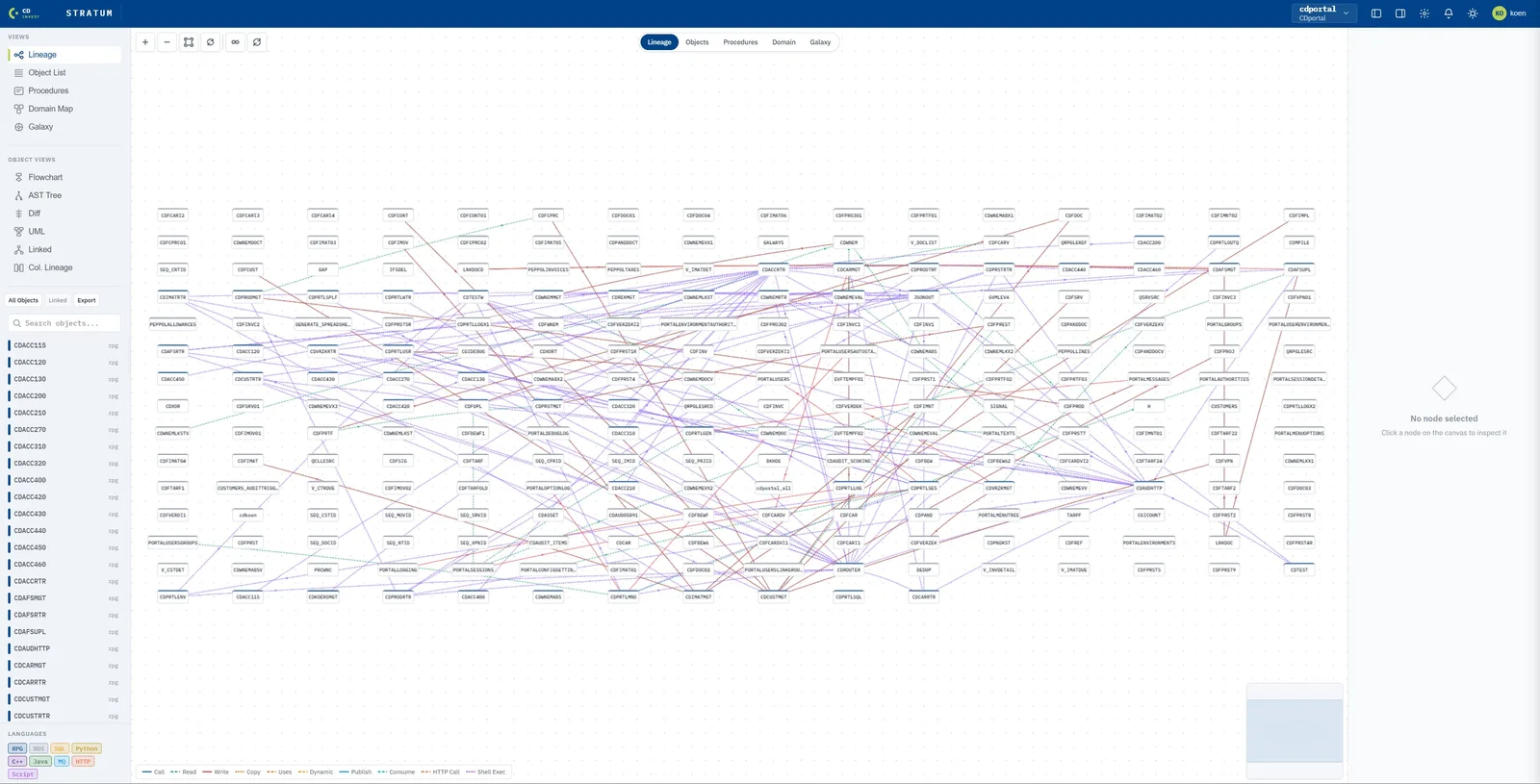
Cross-language dependency view — every node a real object, every edge a verified relationship.
The problem
Enterprise systems are becoming harder to maintain because the people who understand them are retiring faster than organisations can replace them. The code still runs — but the institutional knowledge that explains why it runs the way it does is disappearing.
01
Programs written over decades, with documentation last updated when the original author was still on the team.
02
Service programs called from places nobody remembers; logical files used as invisible access paths.
03
Where does a customer's VAT rate come from? Across how many programs? Nobody can answer authoritatively.
04
RPG, Java, Python, and C++ in one enterprise. Each language has its own tooling — none of them connect.
05
DORA, GDPR, and audit requirements demand traceability the legacy estate cannot produce.
06
Cursor, Copilot, IBM Bob, and Claude Code are powerful — but they hallucinate when handed an undocumented codebase.
The solution
Point Stratum at your codebase. It automatically maps program-to-program dependencies, traces field-level data lineage, explains business logic with AI, and exposes the entire knowledge graph to AI coding agents through MCP.
The mental model
Structure the knowledge first.
Generate the code second.
Verify with data third.
Four core capabilities
From static analysis to AI-agent access — Stratum unifies the four intelligence layers enterprise AI engineering actually needs.
Capability 01
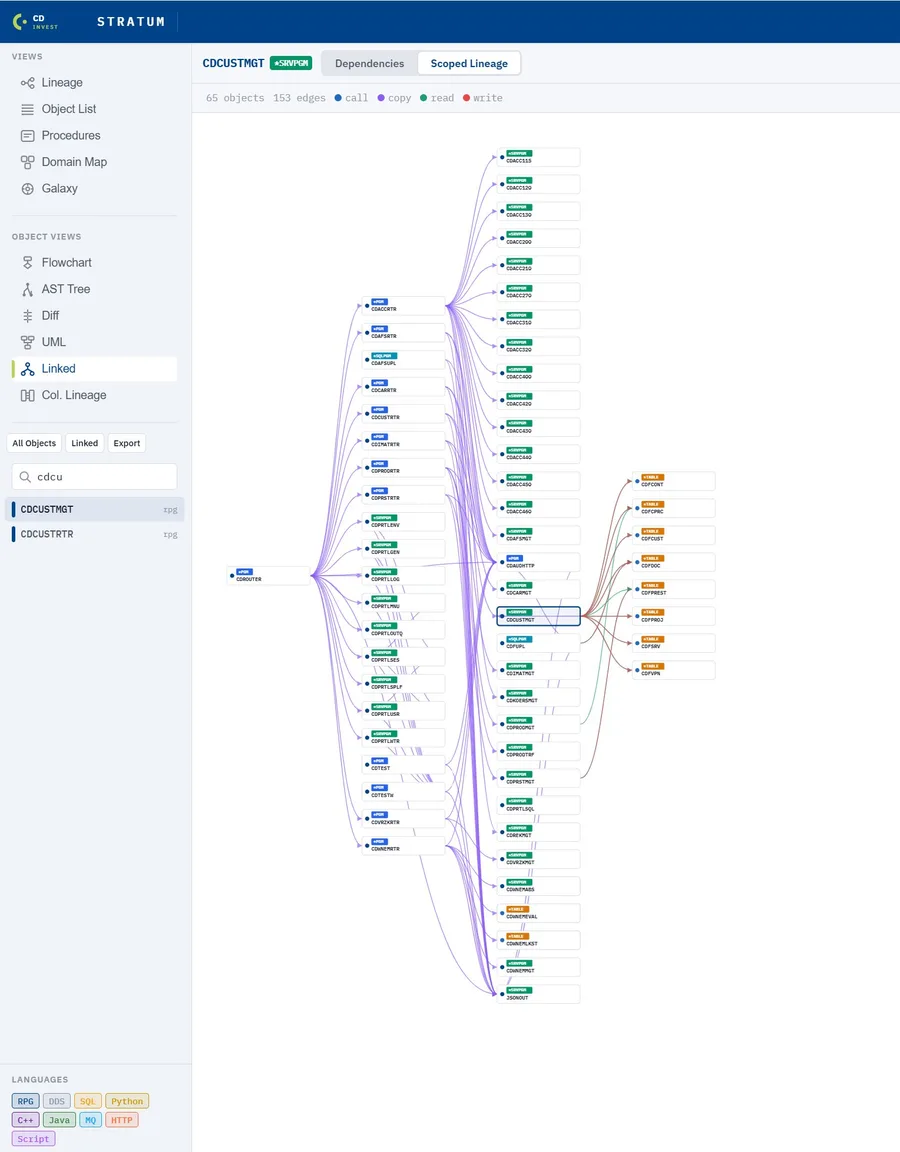
Stratum analyses legacy and modern enterprise codebases and builds a live dependency graph that shows program calls, procedure relationships, module interactions, and data flow across systems.
Scoped lineage for one program — 65 objects, 153 edges, colour-coded by relationship type.
Capability 02
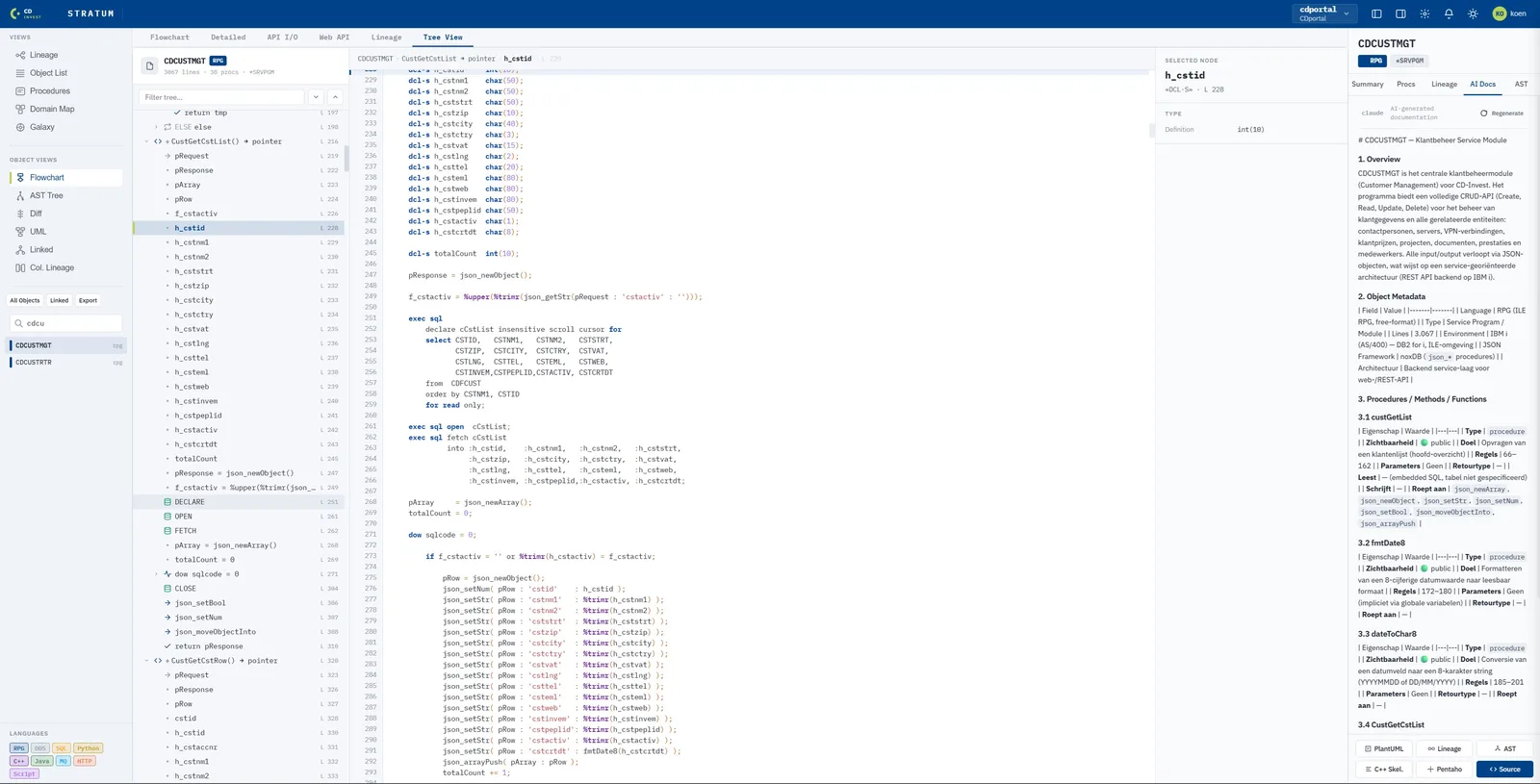
Using Claude-powered semantic analysis, Stratum generates program summaries, procedure explanations, business-rule descriptions, and technical documentation — regenerated whenever the code changes.
Procedure tree, synchronised source, and AI-generated documentation in one view.
Capability 03
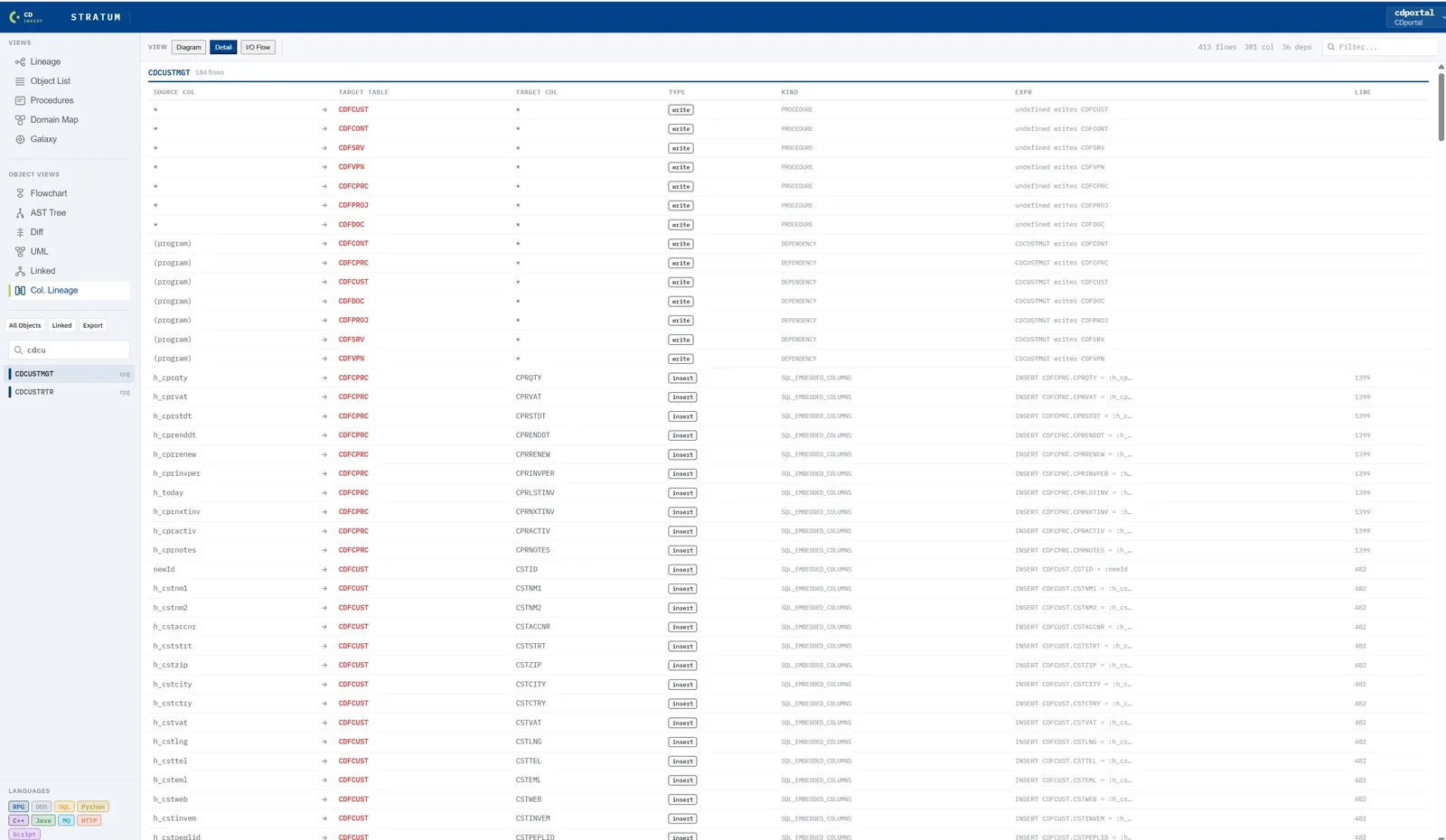
Stratum generates detailed metadata in the OpenLineage standard — column by column, program by program. The result feeds governance platforms like Collibra, supports DORA traceability, and gives your CDO a data flow map the legacy estate never had.
Detailed column lineage: 413 flows · 381 columns · 36 dependencies — for one service program.
Capability 04
Stratum exposes the intelligence graph through a Model Context Protocol server. Claude Desktop, Claude Code, and other AI coding agents query structure, run impact analysis, retrieve lineage, and access semantic docs — natively.
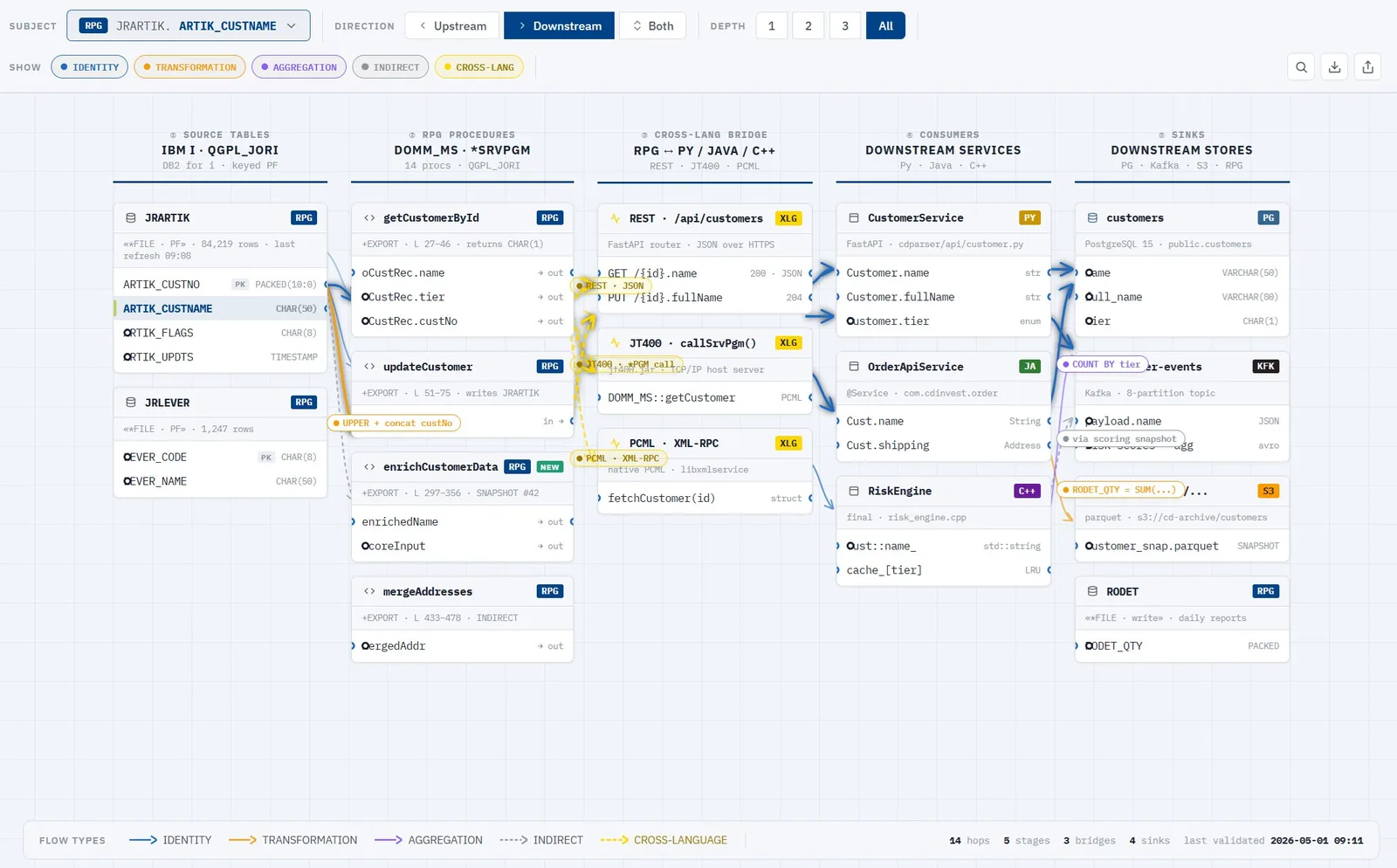
End-to-end lineage across languages: DB2 → RPG procedures → REST/JT400/PCML bridge → Python, Java, C++ services → PostgreSQL, Kafka, S3.
Proof point · Capability 04 in practice
Stratum's MCP server exposes 13 first-class IBM i tools to Claude Code and other AI agents — turning the intelligence graph into a development workflow agents can drive end-to-end.
01
Inspect the estate
02
Drive the compile chain
03
Query and modify DB2 for i
04
Scaffold and configure
Example workflow · agents chain these tools end-to-end
The 2026 agent stack
Production-grade AI engineering in 2026 is not one tool. It is four layers working together — and Stratum sits at the centre.
Know-how
Reusable procedural instructions in markdown. Skills teach agents how to use tools — naming conventions, contracts, modernisation rules. Portable across any MCP client.
Connectivity
Model Context Protocol — the integration standard for AI agents. JSON-RPC 2.0 over HTTP/SSE, OAuth, audit logs. Stratum ships through an MCP server.
Execution
Unix-style local execution. Composable pipes — git, gh, curl, jq. Token-efficient and leverages model pre-training on standard developer tools.
Orchestration
The runtime that combines all three. Claude Code, Cursor, Bob — each decides when to load a Skill, call an MCP tool, or shell out to CLI.
Stratum is built to plug into this stack — not replace it. Bring your preferred agent and skills; Stratum supplies the system intelligence they need.
Spec-driven development
SDD turns AI from a productivity boost into a deterministic engineering practice. The spec defines what is correct; the agent executes against it as a validation gate.
Intent, user journeys, requirements, acceptance criteria, edge cases, failure modes.
Architecture — tech stack, dependency graph, data contracts, API surface, test strategy.
Granular execution — discrete, dependency-ordered items with explicit acceptance criteria.
AI-constrained generation — agent executes against the spec as a validation gate.
Where Stratum fits
Step 2.
Of the two it takes.
Step one is writing the spec. Step two is giving the agent the system intelligence it needs to execute against that spec correctly — the dependency graph, the column lineage, the AI documentation, the impact analysis.
Without that intelligence, the spec describes a system the agent cannot reason about.
Strategic positioning
Stratum is an AI-ready system intelligence layer for enterprise software. It combines six things that no other tool combines in one platform.
Parsed ASTs and verified call graphs — not LLM guesses.
RPG · Java · Python · C++ in a single graph.
OpenLineage standard, field-level, ready for Collibra.
Claude-generated documentation that updates with the code.
MCP server exposes everything to Claude Desktop and Claude Code.
Audit trails, Keycloak SSO, self-hosted on Linux.
Not a documentation tool. An intelligence layer.
Vibe coding ends where intelligence begins.